- BIG Risks: Everyday Decisions
- Posts
- 🎯 A wealth of opportunities starts at your network
🎯 A wealth of opportunities starts at your network
Community and resource building open doors for founders and investors alike.

Bhuva Shakti
February 12, 2026 • Estimated Reading Time: 10 minutes
Hi there,
February is the shortest month in the calendar, and often used to look ahead. In March 2026, I’ll be celebrating International Women’s Day (IWD) with virtual and local New York City events through Wallet Max and several investor/startup organizations. I usually post about these on my LinkedIn page, and you’ll see some similar events listed in this newsletter from the last month.
But in the meantime, I have been working building a stronger resource base with the community. Together with the Wallet Max team and our partners, I am launching new hands-on workshops like Fundraising Mastermind and preparing for the next Fintech/AI Startups Pitch Competition. I’ve also interviewed tech-conscious entrepreneurs Brandi DeCarli of Farm from a Box and Bobbie Shrivastav of Solvrays.
And before I forget: Share this newsletter with your founder friends and colleagues looking to boost their fundraising efforts in 2026.
Outside of networking and resource building, I have been intensively reading numerous 2026 reports, as many investors and entrepreneurs are. Here, I’ll review key AI risks from the World Economic Forum (WEF) and where ethical AI might be the ideal agent to counteract potential tech risks to the economy.
Of course, that’s just a summary of main points. Keep reading for a full roster of news, insights, and reflections.
Upcoming Events
Join the Launch: Fundraising Mastermind (February 18)
Over the past few years, I have mentored hundreds of entrepreneurs and executives in a 12-step program to fast-track fundraising efforts. Starting on February 18th, I am launching a 12-week mastermind sprint to help founders work through every step. Our goal is timeboxed and accelerated fundraising.
Rather than pay $300 or more per hour for a consultant, founders can join our Fundraising Mastermind. Each week for 3 months, founders can expect a 1-hour group session plus dedicated time with your mastermind group. Bonus: You get 2 dedicated coaches every week. The primary requirement is time: You will need to invest 6-8 hours weekly toward your fundraising goals.
The weekly breakdown is simple 👇
Launch & Goal Setting
Fundraising Readiness & Foundations
Credibility Code
Investor-Ready Story & Deck Architecture
Overcoming Rejection
Fundraising Checklist, Metrics & Traction
Crafting Investor Emails That Get Responses
Outreach Systems & Investor Pipeline
Due Diligence Tooling
Diligence, Decisioning & Closing
Storytelling Mastery
Long-Term Capital Strategy & Positioning
If you’re ready to optimize your fundraising efforts for the 2026 market, sign up today or get more details on the Wallet Max website. You can also email the Wallet Max team at [email protected] for more information.

Fintech/AI Startups Pitch Competition (April 20)
One of my favorite events of the year is New York Fintech Week. And what better place is there to host a startup pitch competition?
While pitches take center stage, this event also features an informative panel. Judges and industry experts weigh in on connecting with impact investors and corporate executives while enhancing sustainable and inclusive practices at your startup or firm. This section is often filled with practical, lived advice that benefits the entire startup-investment ecosystem and demystifies the AI hype.
You may be asking, who will be attending? Let me share some of our investors and industry experts as the judges and panelists for 2026 (more to come):
Sherrise Pond, Investment Principal at Anthemis Group: has over 15 years of experience in finance, spanning investment banking, mergers and acquisitions, and credit analysis.
Jessie Lam, Venture Partner at AiiM Partners: has 20 years of experience in investments, operations and finance, with a career that brought her around the world and spanned multiple asset classes.
Haroon Chohan, Managing Partner at ARC Capital Management: is a startups advisor at Cornell University, with decades of capital allocation experience and scaling product-market fit across diverse business models.
We are also proud to highlight some of our startup contestants (more to come):
Adnan Haider, Co-Founder of Quantuma
Ghassen Benhadjsala, Co-Founder of Inncivio
Shivam Goyal, Co-Founder of Merble
We still have space for a few more judges/speakers and pitching startup spots. Deadline for startups to submit interest for pitching LIVE is February 28th.
Don’t wait: Sign up today 👇

Past Event Highlights
Dive into key learnings from the past few weeks of in-person and virtual events.
Fundraising Fast-Track: Tech Founder’s Sprint for Investor-Ready Growth
Earlier this month, I hosted a workshop with The Fourth Effect, a startup ecosystem that connects founders and investors. I provided tech founders a step-by-step system to run a focused fundraising sprint. This 12-week plan makes it easier for founders to organize outreach, build momentum with updates, and use real investor benchmarks to measure progress.
Ultimately, attendees left the session with a practical fundraising readiness toolkit with sprint plans, pitch checklists, and my proprietary simple framework for aligning story, numbers, and next steps.
This is one of my key online offerings for new founders, which means I’ll be offering this training again soon. Any founder in pre-seed, seed, or Series-A/B can benefit from my 12-week sprint driven fundraising - either new rounds, first time fundraise, or expansion to late-stage fundraising, or even bridge rounds.
Mentorship at Entrepreneurs Roundtable Accelerator
Over the last couple of months, I was thankful to attend the Entrepreneur Roundtable Accelerator (ERA) as both a mentor and advisor to startups pitching to investors and demoing their solution. The ERA is New York City’s premier and longest-running program that brings together founders, investors, and ecosystem leaders.
I also separately met with and mentored 14 startup founders and their team members across 6 startups, and advised on the state of fundraising in the US and how investors are evaluating their next investments, be it angels or VCs.
So much about my current work centers on mentorship and community building. I am lucky: This is the time to build in-person. Professional networks are expanding beyond Manhattan as founders, investors, and policy makers look to expand. Our New Jersey mentor meetups are one example of startups/VCs thinking beyond traditional geography.
VC/LP Gallery: NYC Powered by AngelList
Similar to my work with ERA, I attended the Venture Capital / Limited Partners gathering last month an angel and LP investor, and a fundraising advisor. Unlike the ERA, this event focused on late-stage startups along with a private art tour of the gallery by the owner.
While it’s a fun night-out, much of the discussions center on work: Fundraising and supporting new innovation, especially in technology, AI, fintech, and sustainable ventures.
In short: These events are never just coffee or friendly mingling. It’s an act of moving forward.
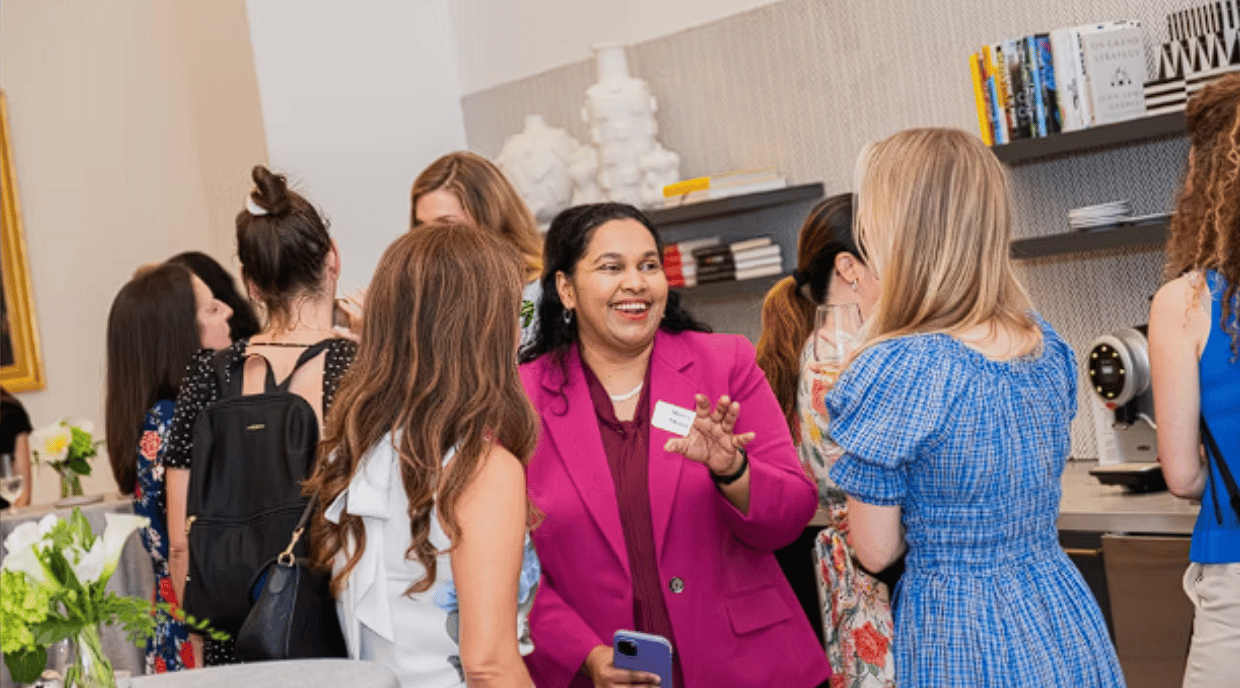
Building Intimate and Intentional Communities!
Startup Growth Playbook: LIVE Interviews
How Climate Infrastructure Startups Actually Scale with Brandi DeCarli
Founder and CEO of Farm from A Box, Brandi DeCarli is building climate-resilient food systems using clean infrastructure, digital tools, and innovative financing - while proving that impact and profitability can scale together.
In our recent Startup Growth Playbook discussion, we covered:
✅ What real traction looks like beyond pilots and press
✅ How to align impact, operations, and revenue
✅ How founders should communicate momentum to investors
Traction and impact alignment mirror each other. If you build a product that properly addresses customer problems, you’re likely to see interest snowball. Brandi leveraged this traction when growing Farm from a Box and scaling its climate-focused infrastructure.
“Farming is one of the most under-digitized areas. But it can’t just be ‘teched up.’ It has to give real value to the farmers,” said Brandi. “But we have used AI and technology strategically. A part of scalability is learning how we could serve our farms.”
Technology or not, the network is critical to success for any founder.
“Activate your network. If you don’t have a network, go activate it. You have no idea who could make an introduction, who could be an investor, or who could be an advisor,” notes Brandi. “And be real.”
Don’t miss this engaging interview with real-world tips from Brandi. You see the full Playbook episode below 👇
How Customer Delight Drives Revenue Expansion with Bobbie Shrivastav
In this Playbook episode, I spoke with CEO and Co-Founder of Solvrays, Bobbie Shrivastav about scaling AI-native startups inside legacy industries. With eight years of insurtech experience and two decades of technology experience under her belt, Bobbie is overcoming legacy insurance challenges with AI innovation.
We covered a number of essential topics, including:
✅ What traction looks like in regulated, legacy-heavy markets
✅ Turning operational efficiency into scalable growth
✅ Building trust with customers and investors in AI-driven businesses
The secret to success in traction and entrepreneurship is building an authentic community network that gives as much as it takes. Being present is the first step to developing trust with investors and customers.
“Entrepreneurship is for everyone,” notes Bobbie. “The key is that you don’t need permission to do what you want to do. What you need is clarity, consistency, and community.”
Bobbie dives deep into her journey in insurtech, building trust with customer and key stakeholders, and more. Watch the full replay below 👇
In Case You Missed It – The BIG News Highlights
Risk is everywhere, but in understanding potential threats, we can mitigate them. Below is one BIG story that shows the connections between technology, economics, and climate.
AI Risks, Trends, Workforce, and Leadership in 2026
Artificial intelligence (AI) is risky. In The World Economic Forum’s Global Risks Report for 2026, business and policy leaders said adverse AI outcomes will be one of the top global risks within the next 10 years. The report states that there are three primary AI technology risks:
There’s a potential for negative labor market influences with mass unemployment straining social structures.
Uncertainty regarding AI application: Will it incite creativity or contribute to social decay?
Unethical or incorrect use of AI technologies can lead to harm.
Despite these potential threats, BDO’s Tectonic States report found that 55% of business leaders believe their organization’s leadership clearly understands risks associated with AI.
Indeed, this is a significant issue that requires more than technical understanding. We are dealing with the transformation of not only economies but of purpose.
Wharton’s and Accenture’s AI-Skills Index Report highlights the rising disparity between job descriptions and skillsets. Artificial intelligence is changing the way we think about skillsets and productivity. This addresses, in part, the economic concerns about AI. Instead of focusing on job depletion, it may be beneficial to view AI and the future of work as reshaping skills.
The answer to the current and rising market-skill mismatch is realignment. Determining what skills are intrinsically human should develop a new economic structure focused on high-level thinking, not repetitive work.
But there are ethical considerations, too. BDO’s Key Trends in Artificial Intelligence for 2026 names several shifts in AI use, including ethical AI. privacy. One of the primary considerations is data-usage for AI-training. Organizations must verify that when AI has access to personal information and other sensitive data. They must review security protocols and ensure that only authorized users can access it. These considerations are not just good faith practices. Ethical AI use is about reducing risk exposure, such as avoiding copyright lawsuits or cybersecurity breaches.
In the future applications of AI, we see the intersections of risk, finance, and economy. There are potential routes that can lead to compounding economic and financial strain.
Likewise, with forethought around AI culture and application, it’s possible to design a world where workers are not shaped by job descriptions but let their skillset shine. Future technology does not have to be a liability, but an asset. Risks become real when we do not prepare for them, and the time for that preparation is now.
The BIG Blog Digest
Still time for some reading? Here are some articles of interest this month.
3 ways to apply machine learning to risk management
Increasing international and local regulations regarding climate, business operations, and financial risks bring additional pressures Artificial intelligence (AI) and Machine Learning (ML) tools offer organizations and governments the ability to assess risks rapidly. Institutions can leverage AI for risk assessments, predictive analysis, and fraud detection, but they must consider ethical use before implementation. Read this full blog here.
How fintech startups can secure funding
While some fintech startups have successfully bootstrapped their way to success, leveraging personal funds or reinvested profits for growth, this path is fraught with limitations, especially in a capital-intensive industry like fintech. A solid business model and a clear regulatory compliance strategy are non-negotiable for fintech startups aspiring to secure funding. And for most of our listed 11 funding options, awareness of compliance can make the difference. Read this full blog here.
Turning WEF risk insights into practical AI decisions
Major risks gleaned from discussions at the World Economic Forum (WEF) are that AI is scaling faster than oversight while the global economy is fragmenting and trust is in short supply. And in a fragmented world, AI does not create new problems. It magnifies existing ones. Leaders can repel risk when applying discipline and clarity to AI decision-making. My 15-minute Davos Reality Check reflection for business leaders is a great way to jumpstart the process. Read this full blog here.

Giving Back to Empower the Next Generation!
Risk Lesson: Movement is Expansion
In the modern world, we are often conditioned to seek recognition. Likes, titles, promotions. But some of the most meaningful progress happens when no one is clapping. It happens in the small, often unseen decisions like choosing to stay up late to study, listening deeply in a discussion when you don’t understand everything yet, building up the strength to walk into the room again tomorrow.
For many years, I felt invisible, first as a girl in rural India, later as an immigrant in America. But I came to realize that just because something is invisible doesn’t mean it’s insignificant. Invisible work is not wasted effort.
But it’s easy to lean into the comfort of being invisible, of being “safe.” That is a mistake. It’s better to train yourself to take risks, to move when it feels easier to stay.
In my book, Everyday Risk Wisdom: Your Risk Management Guide to Thrive in a Complex World as an Overlooked Business Leader, I have a lesson fully devoted to help you better associate risk with growth.
Explore my book website below and get notified when this lesson is available for free!
The BIG Reflection Quiz
You know by now that I love repeatable frameworks and introspection. Reflection enables us to be more intentional with our reactions and decisions. That’s why I’ll be adding a reflection question, like this one, at the end of every email, to guide the process.
What am I expanding into? Imagine you receive two funding options for your dream startup. One offers full-funding, but has extensive requirements and ambitious benchmarks. The second provides only 40% of funding, but is more lax and allows you to retain better control over reporting.
Next, review the insights from the Movement lesson. Would you change your answers if you were focused on growth rather than risk?
Read the lesson for my “Movement is Expansion” action steps. Explore my book website below and get notified when this framework is available for free!
Power Your Network Today
Staying still is a risk. One of the best ways to counteract risk is to move and grow. This includes your network. But it must be intentional.
I strive to include free, quality resources and insights in every issue. Yet, knowledge is the first step to action. For founders, investors, or business executives ready to take the next step, I heavily recommend signing up for our Startup Fintech Competition as a contestant, judge, or sponsor. Founders, specifically, also have much to gain from structured mentorship in the Wallet Max Fundraising Mastermind.
Next month, Women’s History Month, I will be hosting a number of events and webinars. Among them with the Sustainable by Design: Women Founders and Funders Reimagining Growth on March 5th. Join me, the Columbia Alumni Global Sustainability Network, and Wallet Max to explore how female founders and investors are reimagining growth through a sustainable lens.
All of these events have many benefits. One of the most important of them is nurturing connections.
The connections we make help us to discover ethical and profitable ways to grow our businesses while creating a positive impact. I’m always grateful for the mentors, advisors, and partnerships I’ve gained along the way. I hope that these opportunities will be just as fruitful for you.
Onward and upward,
Bhuva Shakti, Founder of Wallet Max and Bhuva’s Impact Global.
Let’s collaborate, send me your ideas! www.bhuvas-impact.global/bhuva